Monday, May 4, 2009

IFR Training In The Airplane


Now that I have almost 15 hours in the simulator with a CFII I am transitioning into flyhing IFR in a real airplane. Ron let me use the Cherokee 140 to go "get some learnin'" with CFII Steven Wilson. Here we are in the mighty N6794J about to go out for our first lesson. We kept it simple, just tracked VOR radials, flew assigned headings, maintained altitude, constant speed climbs, constant rate decents, and more...ok, so not SO simple...but really just the basics of IFR flight.

In The Simulator


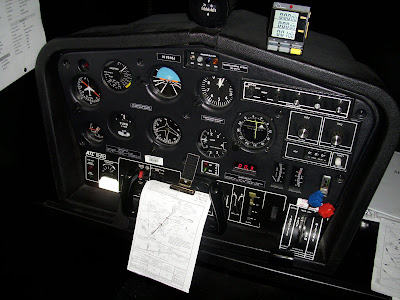
I've been training in the ATC 610 simulator at Palomar College in San Marcos for a few months now. It's a fully FAA authorized simulator so when I have a CFII with me I can log the time. I can log up to 20 hours in the simulator and I am already at 14. My CFII (Certified Flight Instructor, Instrument) is Diane Hager and she has been great. She lets me do the flying and she lets me make the mistakes...THEN she adds a comment or two to help me understand why I got into trouble. Although I must say I've only been in trouble once or twice. Mostly it has been about fine tuning and gaining a higher level of understanding.

Most people say that the simulator is harder than an actual airplane and that's fine with me. My thinking was to tackle the hardest thing first. Theorizing that if I could master the simulator first, when I got into the airplane it would be far easier and I wouldn't be wasting any valuable air time. The reason people say the simulator is harder is because you don't get any sensations when flying it, no "seat of the pants" feel. I think that's a bit odd to worry about since one of the biggest things about flying on instruments (especially when you are in the clouds) is that you've got to train yourself to ignore the sensations and trust the instruments. Many times in an actual airplane, in the clouds, you will get false sensations and can really screw the pooch if you don't lock on to the instruments and interpret what they are telling you.

So, I've been able to fly the simulator without having to fight any wrong sensations and I've learned to fly solely by what the gauges are telling me. Next up: Getting into a real airplane and putting on a "view limiting device" while flying with a CFII.

Thursday, April 30, 2009

Simulator Class


I finished up my IFR ground school class at Palomar College in San Marcos, California and took the written test (passed with an 80). Now I'm enrolled in their simulator class. We get the wisdom of Jerry Houser (the stories he tells!) and then we also get unlimited use of the 3 simulators on campus(ATC 610 trainers)

This photo is of Jerry explaining the details of an approach. Jerry doesn't simply explain what's on the page, however, he talks about what to look for- and what to look out for.

Sunday, April 26, 2009

Oceano


Leaving Oceano you take off over the Pacific Ocean, then turn south along the coast. You can see Pismo Beach in this video.

Tuesday, April 21, 2009

IFR Training


I've been studying for my IFR rating for more than a year now, all on my own. It's not easy to read books and totally understand the concepts. So, I enrolled in an IFR ground school class at Palomar College in San Marcos, California to help move the process along. It was a great experience. I boosted my knowledge greatly, plus I had an expert to ask questions of when I was stuck on something. When the class ended I took the FAA written knowledge test and passed with an 80% score. I wanted to be in the 90s, but...I decided to not worry about that anymore. Next up was the simulator class that the school offers. More on that later.

Monday, April 20, 2009

More photos for the fuel line replacement post...


More photos for the fuel line replacement post....

Replacing Fuel and Brake Lines on the Cherokee 140


It has been awhile since I last posted on the Flying37 blog. Some time off after my dad's death was apparently needed. I have been flying a lot and hiking a lot and I'm going to get back into the swing of blogging starting today. First, my flying buddy Ron decided to replace the rubber fuel lines on the Cherokee 140 just because. He also figured that while the tanks were out it would be a good time to replace the brake lines. Nothing indicated that either of these lines needed to be replaced but since they were original factory items from 1968 it certainly wouldn't be a bad idea. There's a lot of screws to be undone to get the tanks out but with a powered screwdriver it's not such a bad job.

After getting the tanks off it became evident that the fuel sensors had been leaking at the seal for quite some time. Not a big leak, but who wants Av Gas in their wing? The fuel lines were pretty shabby. The rubber was rotten (the steel inside was fine) and they looked worse for the wear. The brake lines looked fine, but it felt right to replace them. The local A&P made up new fuel and brake lines and the fuel sensors were sent away to be rebuilt.

With everything else checking out okay, the airplane was put back together when the sensors returned just a few days later. That first test flight after maintenance is always a bit of a nervous time, but N6794J performed flawlessly.